


 English - EN
  繁體 - ZH-TW
  简体 - ZH-CN
  Español - ES
  日本語 - JA
  العربية - AR
  Русский - RU
  Français - FR
The Regulations Never Name Bubble Film. Your Customers Will.
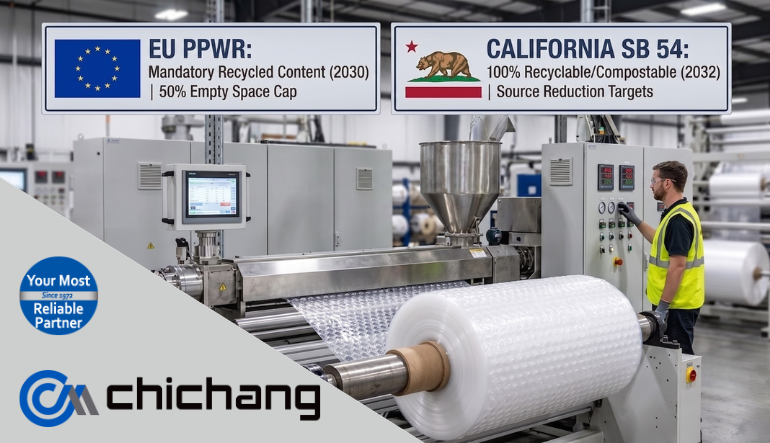
Search the two most-discussed packaging regulations of the past two years — the EU's PPWR and California's SB 54 — and you will not find the words "bubble film." The named items are tea bags, fresh-produce labels, very lightweight carrier bags; the headlines belong to compostable materials and recycling-rate targets. A protective-packaging manufacturer might reasonably exhale.
The new columns on the purchase order say otherwise. Export-oriented converters are finding that brand customers' RFQs now carry questions that were not there before: Can this bubble film go thinner? What share of recycled content does it carry? Is it mono-material — will it actually enter a recycling stream? The regulations never name bubble film, but the procurement standards they shape are traveling straight down to the cushioning line.
Two timelines running through the same summer
On the American side, California's final SB 54 regulations took effect on May 1, and the June 1 producer-registration deadline has already passed. On June 22, seventeen states jointly sued in federal court, arguing that California is using its market size to turn one state's rules into a national standard. The case is worth watching — but it has no pause button for the supply chain. For brands distributing nationwide, standardizing on the California spec is usually the cheapest option, and brand compliance timelines do not wait for a verdict.
On the European side, the PPWR applies from August 12. The dates deserve precision here, because the versions circulating in the market often run ahead of the law: August 12 triggers baseline obligations such as the declaration of conformity; the requirement for named items — tea bags, produce labels — to switch to compostable materials applies from February 12, 2028; and mandatory recycled-content ratios for plastic packaging mainly start from 2030. There is not one deadline but a row of them — and several are aimed squarely at protective packaging.
The clauses that actually hit bubble film
Article 24 of the PPWR caps the empty-space ratio of grouped, transport, and e-commerce packaging at 50%, scheduled to apply from 2030. The key is the next line: the regulation explicitly counts filler materials — air cushions, bubble wrap, foam, paper — as empty space. In other words, stuffing the box with more cushioning is no longer the fix; it is the thing being regulated. The direction for e-commerce and logistics customers is clear: boxes get right-sized, void fill gets cut, and the cushioning that remains has to absorb the same transit risk with less volume.
California's SB 54 presses from the other side: by 2032, covered packaging must be 100% recyclable or compostable, plastic packaging must reach an actual 65% recycling rate (30% by 2028), and total plastic packaging must be source-reduced by 25%. For PE-based protective packaging, those three numbers translate into production language as: thinner, easier to recycle, and carrying recycled content — with all three requirements arriving on the same spec sheet.
On a bubble-film line, that means three concrete problems
Downgauge without popping the bubble:
The instinctive route to source reduction is running the film thinner, but bubble film's value is cushioning: as the film thins, bubble-shape stability, compression strength, and burst rates all show up in the customer's transit-damage figures. Going thinner stably depends on co-extruded layer design — letting each layer do one job — and on die and zoned temperature-control precision, because the thinner the film, the less gauge tolerance there is to spend.
Go mono-material and win the performance back:
The practical route to "recyclable" in protective packaging runs from laminated, mixed-material structures toward PE-based structures that can enter a recycling stream whole. The material family gets simpler; the performance gap has to be closed through layer design, and the demands on process precision go up, not down.
When PCR hits the hopper, the bubble knows first:
The moisture, contaminants, and batch-to-batch melt-index swings of recycled feedstock can sometimes be masked downstream on flat film. In bubble forming they have nowhere to hide: when the feedstock wavers, the bubble shape goes first. Venting, residence time, temperature control — the same fundamentals we laid out last issue on PLA and PCR — are just as much the dividing line on a bubble-film line.
What a 50-year extrusion maker watches for, beyond the spec sheet
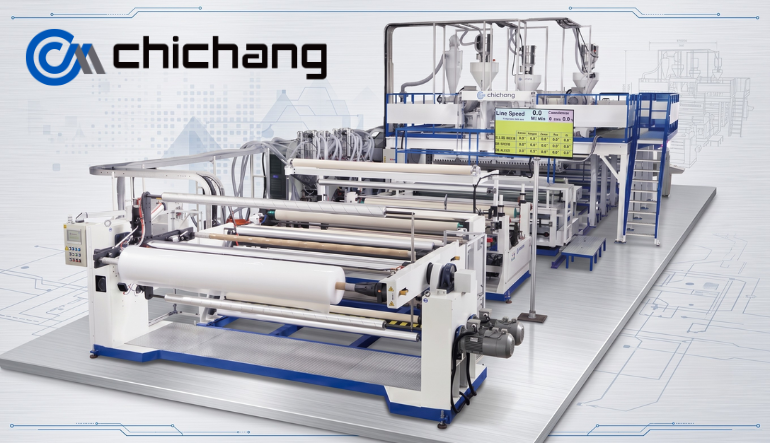
Positioning first: Chi Chang is not a regulatory consultancy — lawyers and trade associations will track the litigation and the implementing acts. Its role is that of an extrusion-equipment manufacturer founded in Tainan in 1972, with air-bubble film, foam board, film extrusion, and multilayer co-extrusion as its core lines, exporting complete lines to the US, Canada, the UK, Japan, and other markets since 1980 — serving export-driven customers for more than forty years.
Fifty years in, Chi Chang has a few "Taiwan firsts" on the shelf — the PS foam-board line, the multilayer PE stretch-film extruder, the CPE breathable-film equipment. Lay the records out and they all come down to the same thing: whatever resin the customer brought in, whatever forming problem came with it, it had to run stable at volume on an extrusion line — or it didn't count. Regulations get rewritten every few years, and every market writes a different list. But on the production floor, the test never changes: can the layer structure flex, can the dies and temperature control hold the line, can the machine digest a material it has never seen. That is the part an equipment maker can think through for its customers before the spec sheet arrives.
The regulations won't name you. Your customers will.
Protective packaging sits in no regulation's headline, but lightweighting, recyclability, and recycled content are being written into brand purchasing specs — one sheet at a time. You don't get to decide when the spec sheet arrives. Whether your line can carry it is something you can find out now.
Are your bubble films or protective packaging starting to get these questions? Don't wait until you have the full spec worked out, call Chi Chang's engineering team today!


合作媒体